Stormwater Runoff Pollutes Our Waters
- darang01
- Apr 17, 2023
- 6 min read
What is stormwater runoff and why does it matter?
When precipitation from clouds falls onto the roads, streets, rooftops and sidewalks, it can push harmful pollutants like fertilizer, pet waste, chemical contaminants and litter into the nearest waterway. As stormwater flows across streets, sidewalks, lawns and golf courses, it can pick up harmful pollutants and push them into storm drains, rivers and streams. These pollutants can include lawn and garden fertilizers, pet waste, sand and sediment, chemical contaminants and litter.
Stormwater runoff can also lead to flooding in urban and suburban areas.
Forests, wetlands and other vegetated areas can trap water and pollutants, slowing the flow of stormwater runoff. But when urban and suburban development increases, builders often remove these natural buffers to make room for the impervious surfaces that encourage stormwater to flow freely into local waterways.
As cities are being developing, the forests and meadows get replaced by buildings and pavement. When it rains it runs off roofs and driveways into the street. Runoff picks up fertilizer, oil, pesticides, dirt, bacteria and other pollutants as it makes its way through storm drains and ditches - untreated - to our streams, rivers, lakes and the ocean. Polluted runoff is one of the greatest threats to clean water in the U.S. [1]
A treatment plant can't solve stormwater pollution, because stormwater runoff comes from small, individual sources in all parts of the watershed. It is a problem that everyone plays a part in solving. It is a problem that residents can change by stopping small, individual activities that cause pollution and result in large-scale pollution. It is a problem that communities can manage to prevent stormwater runoff as development takes place.
Poorly Managed Stormwater Causes Three Big Problems:

Pollution from stormwater contaminates our waters, closes local businesses, and harms or kills fish and other wildlife. As stormwater passes over developed land, it picks up pollutants and transports them to the nearest storm drain eventually ending up in rivers and streams.

Flooding harms streams and wetlands and destroys habitat needed for fish and other wildlife. Unable to soak into the ground, stormwater quickly flows or floods downstream from developed land during the rainy season.

Water shortages in growing communities may occur, especially in developed areas with impervious surfaces or areas where water cannot filtrate through, such as roads, parking lots and rooftops.
3 images from adobe stock https://express.adobe.com/sp/design/post/urn:aaid:sc:US:d0307da8-c52b-400c-9f37-dc6d180c86e1?x-product=CCHome%2F1.0&guid=c8008ab1-798a-4387-bce0-1b220b5869fb
Louisville's Relationship with Stormwater runoff
Stormwater runoff is a significant environmental issue in Louisville, KY, with far-reaching impacts on the health of our waterways, wildlife, and communities. Every time it rains, water flows across the ground, picking up pollutants like oil, chemicals, and debris along the way. This polluted water then makes its way into our streams, rivers, and lakes, causing harm to both the environment and human health.
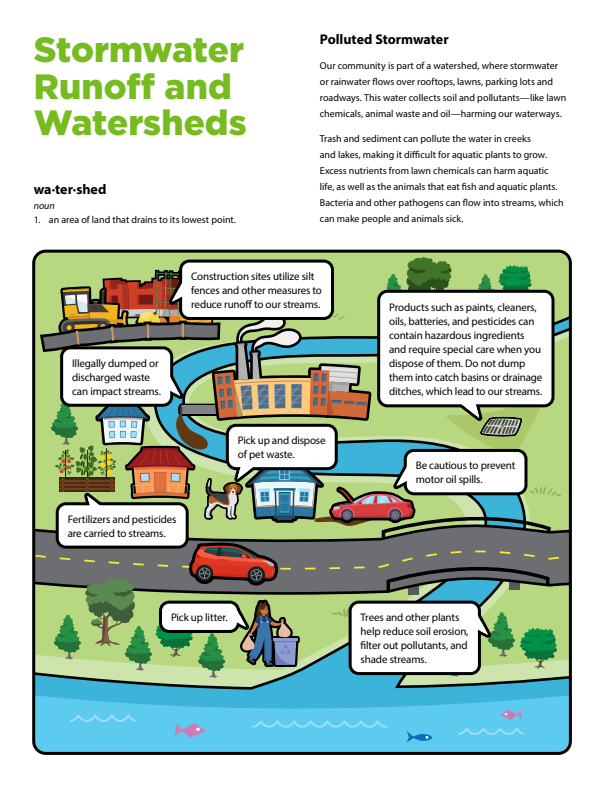
A page taken out of a pamphlet made by Louisville's MSD [3] https://louisvillemsd.org/sites/default/files/file_repository/Education/RivertoRiverWeb2022.pdf
"That is just the normal spring floods we have," said Todd Hornback, the chief of public affairs for the corps. "The ground is more saturated, then we have runoff and that runs into our rivers. It's something traditionally that we have with spring floods."[4]
In 2018, an algae bloom occurred in the Ohio River, affecting the water quality of the river and causing concern for public health. The bloom was caused by a combination of factors, including heavy rainfall and stormwater runoff.
When it rains heavily, stormwater runoff flows across the land and picks up pollutants such as nitrogen and phosphorus from agricultural and urban areas. These pollutants are then carried into our waterways, where they can contribute to the growth of harmful algae blooms.
In the case of the 2018 Ohio River algae bloom, heavy rainfall had caused significant amounts of stormwater runoff to enter the river, carrying with it large amounts of nitrogen and phosphorus. This led to the growth of toxic algae, which produced harmful toxins that posed a risk to human and animal health.
The algae bloom had a significant impact on the local community, as it affected the use of the river for drinking water, recreational activities, and even commercial navigation. The water intake for the Louisville Water Company, which serves over 850,000 people in the Louisville metro area, was affected by the bloom, and the company had to use additional treatment methods to remove the toxins from the water.
Additionally, the Kentucky Department of Public Health issued a warning for people to avoid contact with the river and not to eat fish caught in the river, as they may have been contaminated with harmful toxins from the algae.

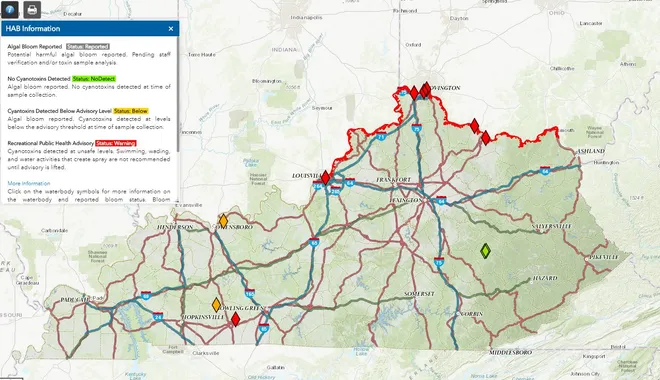


(first image)
(second and third image) https://www.lrl.usace.army.mil/Portals/64/siteimages/CW%20Projects/WaterQuality/2018%20AR/CRR%202018%20AR.pdf
Urban Heat Islands in Louisville
The urban heat island effect refers to the phenomenon in which urban areas are hotter than surrounding rural areas due to the large amounts of impervious surfaces like concrete and asphalt. These surfaces absorb and retain heat from the sun, leading to increased temperatures.
In Louisville, stormwater runoff can exacerbate the urban heat island effect by increasing the amount of heat absorbed and retained by these surfaces. When rain falls on hot pavement, the water can quickly evaporate, leading to a cooling effect. However, when rain falls on cooler surfaces like grass and trees, the water can soak into the ground and be used for plant growth, which helps to moderate temperatures.
When large amounts of stormwater runoff are generated in Louisville, much of it flows over roads and into storm drains, reducing the amount of water that can be absorbed by vegetation and soil. This can lead to higher temperatures in urban areas, especially during heatwaves or extended periods of hot weather.
To address this issue, Louisville has implemented various green infrastructure projects that aim to increase the amount of vegetation and soil in urban areas. These projects, such as rain gardens, green roofs, and urban forests, can help to absorb and retain stormwater, reduce runoff, and moderate temperatures. By reducing the urban heat island effect, these projects can improve quality of life for residents, reduce energy consumption, and mitigate the impacts of climate change.
Sustainable Solutions
Stormwater runoff can have significant impacts on the water quality of Louisville's waterways, including the Ohio River. Implementing sustainable solutions can help manage stormwater runoff and reduce the amount of pollutants that enter our bodies of water. Here are several sustainable solutions that can be used to address stormwater runoff in Louisville, KY:
Green Infrastructure: Green infrastructure uses natural systems to manage stormwater and prevent runoff from entering our waterways. Examples of green infrastructure include green roofs, rain gardens, bioswales, and permeable pavement. These solutions help to absorb stormwater and filter out pollutants, reducing the amount of runoff that enters our waterways.
Sustainable Land Use Practices: Land use practices can have a significant impact on the amount of stormwater runoff that enters our waterways. Encouraging sustainable land use practices, such as limiting impervious surfaces and preserving green space, can help reduce stormwater runoff and prevent water pollution.
Rain Barrels: Rain barrels can be used to capture and store rainwater, which can then be used for watering plants or other non-potable uses. This reduces the amount of stormwater runoff that enters our waterways and provides an alternative source of water for non-potable uses.
Education and Outreach: Education and outreach are important for raising awareness about the impacts of stormwater runoff and encouraging sustainable behaviors. Educational campaigns can teach residents about the importance of reducing water pollution and provide information on sustainable solutions, such as rain gardens and rain barrels.
Municipal Programs: Municipal programs can also help manage stormwater runoff and reduce water pollution. For example, Louisville's Metropolitan Sewer District has implemented a Green Infrastructure Program, which provides financial incentives for property owners to install green infrastructure on their properties.
Restoration of Natural Systems: Restoring natural systems, such as wetlands and riparian zones, can also help manage stormwater runoff and reduce water pollution. These natural systems can absorb stormwater and filter out pollutants, reducing the amount of runoff that enters our waterways.
Overall, implementing sustainable solutions to address stormwater runoff can help maintain the water quality of Louisville's waterways and prevent water pollution. A combination of green infrastructure, sustainable land use practices, rain barrels, education and outreach, municipal programs, and restoration of natural systems can all contribute to managing stormwater runoff and reducing water pollution in Louisville, KY.
References:
[1] United States Environmental Protection Agency. (2023, March 24). Soak Up the Rain: What’s the Problem? EPA. Retrieved April 13, 2023, from https://www.epa.gov/soakuptherain/soak-rain-whats-problem
[2] Department of Natural Resources and Parks, K. C. (n.d.). Stormwater runoff pollution and how to reduce it. King County, Washington. Retrieved April 13, 2023, from https://kingcounty.gov/en/dept/nature/environment-ecology-conservation/stormwater-surface-water-management/stormwater-in-kingcounty/stormwater-runoff
[3] Louisville and Jefferson County Metropolitan Sewer District. (2022). River to River: Louisville's Water Story. Retrieved April 16, 2023 from https://louisvillemsd.org/sites/default/files/file_repository/Education/RivertoRiverWeb2022.pdf
[4] Courier Journal. (2019, February 12). When are the worst Ohio River floods? Louisville's history offers clues. courier-journal.com. https://www.courier-journal.com/story/weather/local/2019/02/12/louisville-weather-when-worst-ohio-river-floods-happen/2839569002/
[5] McLean, D. (2019, September 26). Public health advisory issued after toxic algae found in Ohio River near Louisville. The Courier-Journal. https://www.courier-journal.com/story/news/local/2019/09/26/toxic-algae-ohio-river-louisville-public-health-advisory/3780143002/
Comments